New winter projects: Virgen de Guadalupe and Nuestra Senora de los Pobres
As the final touches are being put on the classrooms in San Pedro, TLAU is already busy preparing for two new projects that will be carried out simultaneously.
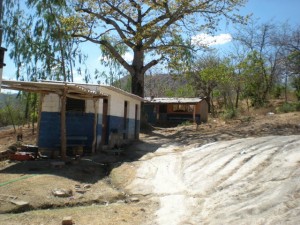
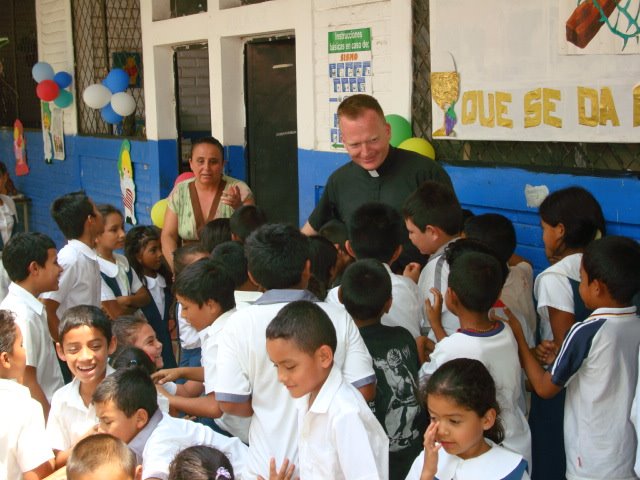
The first project at the Centro Escolar Catolico Virgen de Guadalupe has been in the works for a while, but we have been waiting for them to get their land placed in the name of the local diocese (it is TLAU policy not to improve land owned by the government or private individuals). The school is found in the department of Santa Ana in a very poor “canton” or neighborhood called Cutumay Camones. Most of the school’s 100 students, kindergarten to 6th grade, come from extremely poor families that survive by sorting through garbage at the nearby landfill and selling whatever they find.
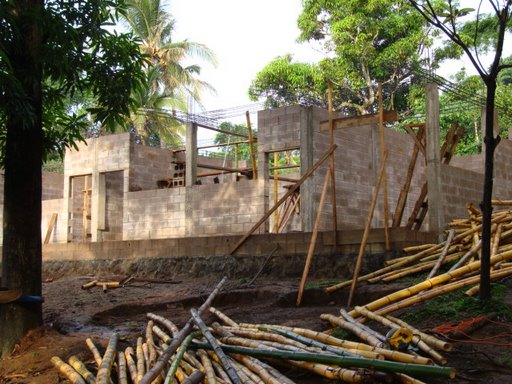
During my visit in March I met with the school’s principal, Benjamin Franklin (his real name or a nickname? the world may never know), and he was very hopeful that the TLAU donors would come to the aid of the school and its children. He begged us to consider beginning the classrooms ASAP, but out of respect for our donors we had no choice but to wait until the land was official property of the diocese. You might not be able to tell from the photos, but the school is in bad shape and the children attend class in very poorly wrought buildings on very rocky land. This is a perfect project for TLAU, and with your help we can provide Virgen de Guadalupe with two very sturdy, durable classrooms that will serve generations of children.
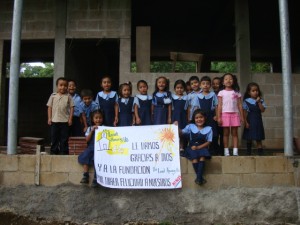
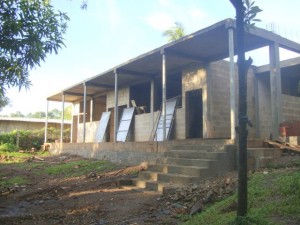
The second project will actually be the continuation of an older project at Nuestra Senora de los Pobres (see older posts), where TLAU (using a generous donation from Jim and Monica Rolquin of North Carolina) constructed two
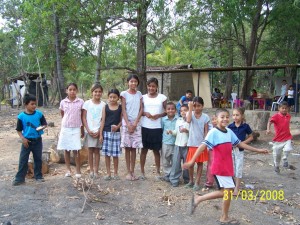
classrooms, bathrooms with flush toilets and provided desks, chairs, and blackboards for the classrooms. But the number of students continues to grow, and TLAU has agreed to provide two more classrooms. Special thanks to the Rolquins for their involvement in this endeavor.
Stay updated through our blog/newsfeed as these two projects begin, and join me in praying for a timely and successful completion of these projects.
 A trip to El Salvador invariably means long hours sitting in the passenger’s seat of Walter’s truck, so naturally I use it as an opportunity to really dig deep into what is going on with TLAU’s Salvadoran operations. As we talked about the scholarship program, which now sponsors seven high school students and three university students, Walter commented on a common mistake made by many non-profits and charitable organizations: slowly degenerating into a simple reservoir of handouts, thereby greatly diminishing the value and power of the donor’s dollar. It works like this: If a donor makes a contribution to TLAU and we in turn give it to a student and do nothing else, even if it is in the form of books, tuition, or transportation, that’s all the charitable donation will bring: a book, a semester of school, or a ride on the bus. Such a transaction also seems to strip the donation of much of its force as a moral statement, leaving it as a bare lump sum of cash. However, if TLAU takes a donation and gives it to a student with the condition or understanding that that student will use his or her gift to help someone in a similar situation, the power of that donation or act of charity is greatly amplified. For not only does the student receive an education and hope for a better future, but that same gift is in turn given to another, and the initial act of charity on the part of the donor reverberates as an act of love should. It’s actually a very simple concept that got me looking for the translation of “chain” and “web” in my Spanish dictionary as I sat in Walter’s truck, and I’m sure you’ve seen it played out or elaborated in other ways, such as the saying “teach a man to fish…” or in that movie Pay it Forward (which I found a little too saccharine).